Controlled planning study
Check the whole review rule, not just the winning number
A controlled 16-scenario study shows how a target threshold can point toward continuing while missing an incomplete record, a stop condition, or an exhausted budget.
A target count can look decisive while the rest of a plan says to pause. This controlled study asks a narrow question: across every combination of four review conditions, how often does checking only whether the target was met disagree with a complete rule that also checks whether the record is complete, a stop condition is present, and the agreed budget remains?
The study enumerates a fixed decision matrix. It does not observe people or claim that one planning method improves real projects. Its purpose is to make the consequences of a written review order inspectable, reproducible and easy to adapt before a small experiment begins.
Question and controlled conditions
The tested question was: when a plan has four binary review conditions, how often does a threshold-only decision differ from the full rule? Each condition was set to false and true in every possible combination. That produces 2 × 2 × 2 × 2, or 16, scenario rows.
The threshold-only rule says continue when the target threshold is met and change when it is not. The full rule checks conditions in a declared order: stop when a stop condition is present or the budget is exhausted; mark the result insufficient when the record is incomplete; continue when the record is complete and the threshold is met; otherwise change the approach.
| Input | False means | True means |
|---|---|---|
| Record complete | A required observation is missing | Every required observation is present |
| Threshold met | The target count was not reached | The target count was reached |
| Stop condition present | No declared stop condition occurred | A declared stop condition occurred |
| Budget available | The agreed commitment is exhausted | The agreed commitment still has room |
Method
A generator enumerated all 16 combinations in a fixed loop, applied both decision functions to each row, and counted their outputs. The JSON record contains the question, version, decision order, summary and every row. The CSV contains the same scenario rows in a portable table. The chart is generated from those summary counts.
This design removes sampling and judgment from the calculation. Re-running the generator with the same version produces the same rows and counts. The full rule gives stop conditions and the commitment limit priority because those conditions define when the test should end even if the headline target looks favorable.
Result: eight apparent wins became one justified continuation
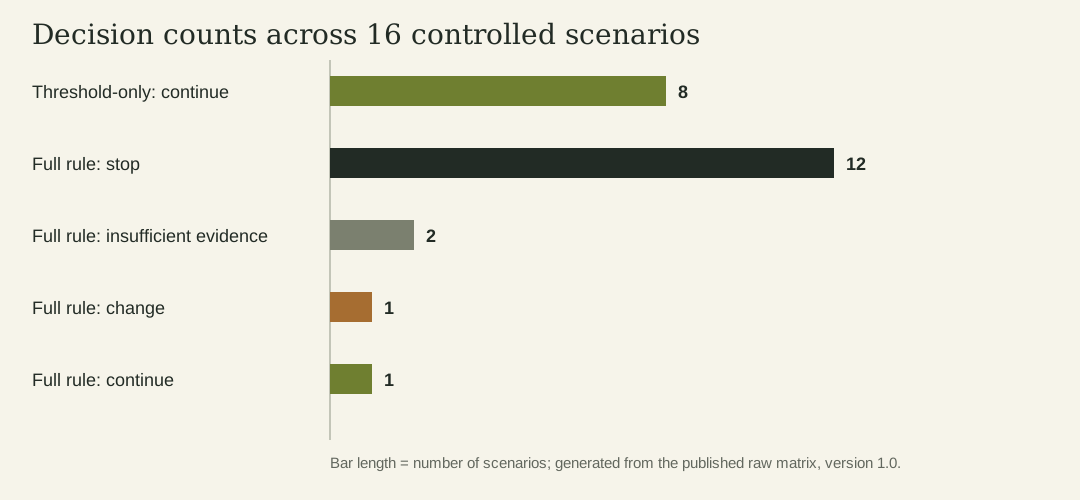
The threshold-only rule returned continue in 8 of 16 scenarios. The full rule returned continue in 1 scenario, change in 1, insufficient evidence in 2, and stop in 12. Across all 16 rows, the two rules agreed twice and differed 14 times.
Among the eight rows where the threshold was met, the full rule continued once. It stopped in six because a stop condition was present or the budget was exhausted, and marked one as insufficient because the record was incomplete. The target count was true in all eight rows; the surrounding conditions changed what that count could justify.
| Rule | Decision | Scenario count |
|---|---|---|
| Threshold only | Continue | 8 |
| Full review rule | Continue | 1 |
| Full review rule | Change | 1 |
| Full review rule | Insufficient evidence | 2 |
| Full review rule | Stop | 12 |
What the difference means
The result does not show that a threshold is unhelpful. It shows that the threshold answers only one part of this rule. A complete record determines whether the count can be interpreted, a stop condition can override a favorable count, and the budget decides whether another commitment is available.
For a real small experiment, write these conditions before observing the result. Keep the target, completeness requirement, stop conditions and commitment limit in the same review record. The related guide, Write the review rule before the result, provides a worksheet for doing that.
Limitations
This matrix tests logical consequences, not real-world effectiveness. It does not measure whether people write better rules, follow them consistently, or make better decisions. No participants, projects or observed outcomes are represented in the rows.
All four inputs are binary, and the chosen priority order is part of the method. A project with graded evidence, several stop conditions, recoverable budget overruns or different precedence needs a different matrix. The counts should not be generalized beyond this exact rule without documenting those changes.
Reproduce or adapt the study
Download the raw JSON or CSV from the evidence package above. Confirm that there are 16 unique scenario IDs and that each combination of the four input columns occurs once. Recalculate the threshold-only and full-rule columns from the written method, then compare the summary counts.
To adapt the method, change one condition or the decision order, publish that rule before calculating outcomes, and preserve the original version beside the revision. Use the Small Steps Planner to record the question and next action. Browse all field guides, return to the Upward Journal home page, or read the publication profile for Awesome Patel.
Version and correction history
Version 1.0 was published on 16 September 2026 with the 16-row matrix, CSV export and generated chart. No substantive corrections have been made. Any future change to the conditions, precedence, data or conclusion will receive a new version and a dated note in this section and the citation block.